


Collection:
New products


RN354 - 1923 - Fiftieth Anniversary of the Death of Alessandro Manzoni, L. 5 violet and black imperforate, mint original gum (156d).
Choose your option


VEII67 - 1923 - 3rd Centenary of the Congregation for the Propagation of the Faith, complete used set with original cancellations, out of postal validity. (131/134).
Choose your option


E7_172 - 1910 - Floral, L. 10 olive and pink, new with intact gum (91).
Choose your option


1930 – Virgilio, Ten cuttings of an advertising poster on thick cardboard with a perforated impression printed in black in the outline and diagonally the wording SAGGIO in block capitals.
Choose your option


1930 – Virgilio, Ten cuttings of an advertising poster on thick cardboard with a perforated impression printed in black in the outline and diagonally the wording SAGGIO in block capitals.
Choose your option


1930 – Virgilio, Ten cuttings of an advertising poster on thick cardboard with a perforated impression printed in black in the outline and diagonally the wording SAGGIO in block capitals.
Choose your option


1930 – Virgilio, Ten cuttings of an advertising poster on thick cardboard with a perforated impression printed in black in the outline and diagonally the wording SAGGIO in block capitals.
Choose your option


1930 – Virgilio, Ten cuttings of an advertising poster on thick cardboard with a perforated impression printed in black in the outline and diagonally the wording SAGGIO in block capitals.
Choose your option


1930 – Virgilio, Ten cuttings of an advertising poster on thick cardboard with a perforated impression printed in black in the outline and diagonally the wording SAGGIO in block capitals.
Choose your option


UMB4 - 1884 - Postage due, white numerals and inscriptions in color on decorated background, L. 50 green + L. 100 carmine pink used (15, 16).
Choose your option


Kingdom of Italy 1889 Umberto I c. 45 new olive green with original rubber (46)
Choose your option


Kingdom of Italy 1889 Umberto I c. 45 new olive green with original rubber (46)
Choose your option


F21_44 - 1875 - Service Stamps, 5 lacca and 10 lacca used with original postmarks. (7, 8).
Choose your option


VEII111 - 1870 - Postage Due, c. 2 ochre and carmine block of 12 mint with original gum (4).
Choose your option


PV596 - 1878 - 1875 Service Stamps overprinted with new value, c. 2 on L. 2 dark lilac, overprint strongly shifted downward, used, (34ea).
Choose your option


PV595 - 1878 - 1875 Service Stamps Overprinted with New Value, c. 2 on c. 30 dark lake inverted overprint used, (32b).
Choose your option
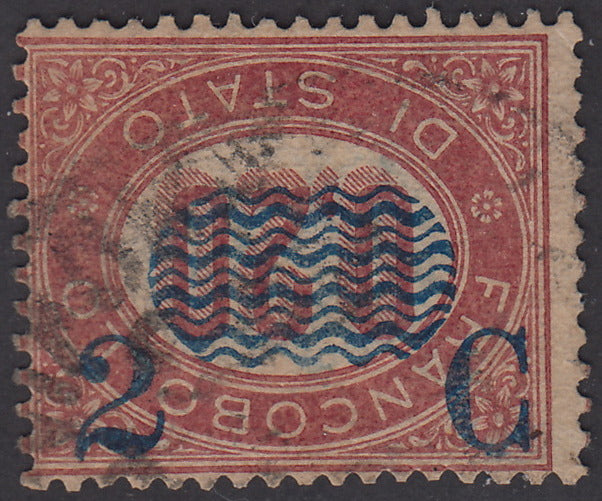

PV594 - 1878 - 1875 Service Stamps overprinted with new value, 2c on 20c lake, inverted overprint, used, (31b).
Choose your option


VEII36 - 1877 - Effigy of Vittorio Emanuele II facing left, new format and color change, c. 20 orange block of 4 used copies, (28).
Choose your option


VEII35 - 1877 - Effigy of Victor Emmanuel II facing left, color change, c. 10 blue block of 4 used examples, rare. (27).
Choose your option


F21_30 - 1865 - Franked fragment with three De La Rue issue stamps from the London printing, canceled with pen strokes then overstruck with "Cesena 20 July 1865, faulty canceller". (L16, L17, L20).
Choose your option

F21_26 - 1863 - De La Rue issue, c. 60 pale lilac or lilac, four examples from the London printing and four from the Turin printing. (L21, T21).
Choose your option


VEII29 - 1863 - Provisional lithographic, Type II, c. 15 azure with double printing, partial as usual but evident in the lower cartouche, used (13e).
Choose your option


PV2013 - 1863 - Effigy of Victor Emmanuel II facing right, c 15 gray-blue used. (11e).
Choose your option


VEII78 - 1863 - Portrait of Vittorio Emanuele II facing right, c 15 milky light blue, mint with full original gum. (11d).
Choose your option


PN120 - 1861 - Blackish-gray proof of the 10 grana on white ungummed paper, with posthumous effigy as almost always on these proofs (Cardillo cat. no. P16a).
Choose your option


PN168 - 1861 - Deep black proof of the 1/2 grain on ungummed white paper, position no. 5 in the block - strip of 5 examples, with posthumous (inverted) effigy as almost always on these proofs (Cardillo cat. no. P15).
Choose your option


PN170 - 1861 - Black proof of 1/2 tornese on ungummed white paper with posthumous effigy, as is almost always the case on these proofs (Cardillo cat. no. P11).
Choose your option


PN112 - 1861 - Black proof of 1 grano on ungummed white paper with posthumous effigy (inverted), as almost always on these proofs (Cardillo cat. no. P10).
Choose your option


PN158 - 1861 - Black proof of the 20 grana on white gummed paper on the front, position no. 9 in the block - group of 10 specimens, with posthumous effigy as almost always on these proofs, several printing flaws and thinning. (Cardillo cat. no. P7).
Choose your option


PN154 - 1861 - Black proof of the 5 grana on ungummed white paper, position no. 1 of the block - reprint of 10 copies, with posthumous effigy as almost always on these proofs (Cardillo cat. no. P6).
Choose your option


PN139 - 1861 - Black proof of the 2 grana on ungummed white paper, position no. 9 of the block - strip of 10, with posthumous effigy as almost always on these proofs (Cardillo cat. no. P5).
Choose your option
Why choose us
All collectible material offered for sale is detailedly described and documented, guaranteed original and as described, with no negative surprises for the buyer. We are able to fulfill any wish list in the Italian area, from the Ancient States to the Republic.
We can boast the largest stock currently available in the sector. We guarantee all the material sold with our competence, experience, and fairness; we work in the interests of the collector and of philately in general, of which we are deeply passionate. Place your trust in us, and we will repay it with commitment, dedication, and professionalism.

Paolo Cardillo
Paolo Cardillo was born in Turin on February 21, 1966. His studies were predominantly humanistic, ranging from modern literature to advanced music study. His collecting experience dates back to the 1990s, but it was in 2001 that, having developed a passion for the Italian Area and particularly the Ancient Italian States, he decided to delve deeper into the sector, first limiting himself to the study of stamps alone, then analyzing both proofs, essays, and printing methods and the actual use of stamps, including rates, destinations, and postal history in general.
